₹1 lakh in twenty days, then ₹1 lakh in one day: a Kannur marketing case study
A new FRP planter store in Kannur had a good product, a live store and almost no sales. Twenty days in, the founder messaged us saying he was frustrated. Three weeks later, one reel did his entire previous month's revenue in a single day. This is exactly what changed — and what did not.
The client: a new D2C brand in a crowded local market
Vassio sells FRP (fibre-reinforced plastic) planters — the large decorative pots you see in villa courtyards, hotel lobbies and balcony gardens across Kerala. The category is genuinely competitive in Kannur. Plenty of local suppliers, plenty of price-led competition, and a buying decision that is almost entirely visual: people buy a planter because of how it looks in a space they can imagine being their own.
They came to us as a new brand. No audience, no content history, no proof. What they did have was a product that photographed well and an owner willing to keep going.
The problem: twenty days, one lakh, and a frustrated founder
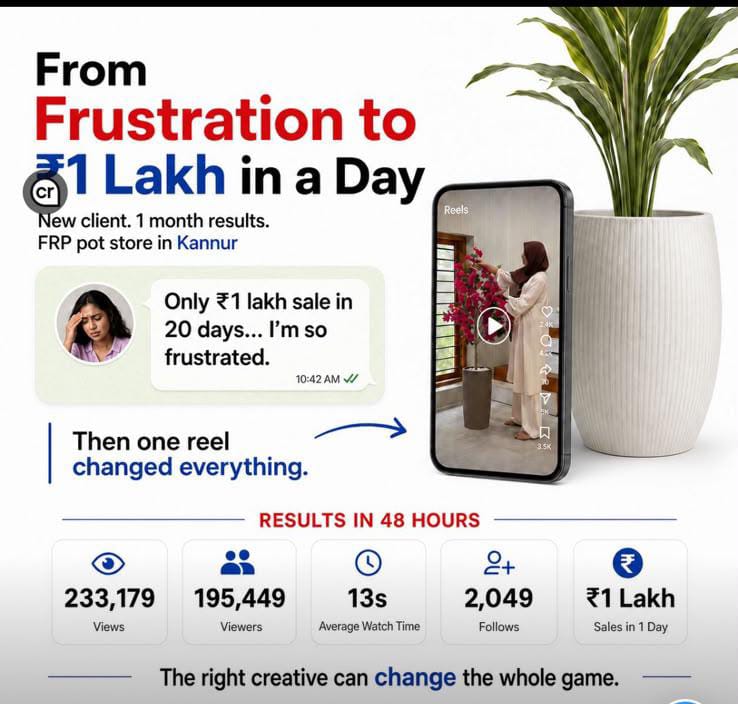
“Only ₹1 lakh sale in 20 days… I'm so frustrated.”
That message arrived at 10:42 in the morning, twenty days into the engagement. It is worth being honest about what that moment feels like from an agency's side, because most case studies skip it. Twenty days of work, a client losing faith, and no breakthrough to point to.
The temptation at that point is to panic — scrap everything, rebuild the strategy, change the entire creative direction, and be seen to be doing something dramatic. That instinct is almost always wrong. Starting over resets your learning to zero, and you lose the very data that tells you what to do next.
What we actually did
Instead of rebuilding, we kept running the process and read the data properly.
1. We held the strategy and changed only the creative
The targeting and the offer were sound. What was not landing was the content itself. So we kept the structure fixed and treated creative as the single variable — which meant that when something eventually worked, we would know precisely why.
2. We studied who was actually watching
Not who we assumed the buyer was. The audience data showed us the real watch patterns: who stopped scrolling, at what second they dropped off, and which frames held attention. For a visual product like planters, that second-by-second retention curve is the most useful thing you have.
3. We rebuilt the content around the insight, not the product spec
The early content did what most product content does — it showed the product and described it. The insight from the watch data was that people were not stopping for a planter. They were stopping for the space. So the creative shifted: the planter in a real Kerala home, in real light, with a person in frame. Context first, product second.
4. We tested weekly, not monthly
New angles went out every week against the control. A monthly review cadence would have cost us three more weeks before we found the winner. That difference is often the entire gap between a campaign that works and a client who quits.
5. We put weight behind the winner the moment it moved
When one reel started outperforming, we did not wait for the weekly review. Budget and distribution went behind it inside hours.
The 48 hours that changed the account
One reel broke the pattern. Within two days:
- 2,33,179 views from 1,95,449 unique viewers
- 13 seconds average watch time — unusually high for product content
- 2,049 new followers
- ₹1 lakh in sales in a single day — the figure that had taken the entire previous month to reach
The average watch time matters more than the view count. Views tell you the algorithm pushed it. Thirteen seconds of held attention tells you people actually wanted to watch, which is why the algorithm kept pushing it and why the sales followed rather than just the vanity metrics.
Why it worked — and why it is repeatable
It is easy to look at a result like this and call it luck. Some of it is: no one controls which piece of content the algorithm decides to distribute. But three things made the brand ready to catch that break when it came.
- Volume of attempts. Twenty days of consistent testing produced enough shots that one of them landing was a matter of time, not chance.
- The insight was real. The winning reel was not a random variation. It came from watch-time data that told us to lead with the space rather than the product.
- The business could absorb it. Stock was ready, the ordering process worked, and enquiries were answered fast. Plenty of brands go viral and convert nothing because the back end is not ready.
What this means if you run a business in Kannur
Most local businesses we speak to in Kannur and across Kerala have the same two beliefs, and both are costly. The first is that results should appear within a week. The second is that if the first few pieces of content do not perform, the channel does not work for their category.
What actually happens is closer to this campaign: a slow, unglamorous stretch of testing where nothing obvious improves, followed by a sharp break once you find the angle. The businesses that win are simply the ones still testing when the break arrives.
Strategy creates the opportunity. Creative creates the breakthrough.
Frequently asked questions
How long does social media marketing take to work for a Kannur business?
In this case, roughly three weeks before the breakthrough. Most accounts show a clear directional signal within two to three weekly creative cycles. Anyone promising results in the first week is guessing.
Does going viral actually produce sales?
Only when the offer and the operations behind it are ready. This reel produced ₹1 lakh in a day because the store could take and fulfil orders. Reach on its own produces views.
What does a marketing agency in Kannur cost?
It depends on ad spend and scope. We scale the retainer to account complexity and confirm the right level on a free audit call before you commit to anything.
Marketing does not always reward you immediately. Sometimes the right creative needs time, testing and consistency before it clicks — and the brands that win are the ones still testing when it does.
Work with us
We are a marketing agency based in Thana, Kannur, working with D2C brands, retailers, restaurants and builders across Kerala and the Gulf. If you are in a stretch that feels like Vassio's first twenty days, that is usually a data problem rather than a channel problem.
See how we run performance marketing · how we produce the creative · read the Shoobeedoo ₹1 crore campaign
Email us or call +91 70128 12012 for a free account audit.